Poodle Teething: From 28 Puppy Teeth to 42 Adult Teeth
By The Poodle Guide editorial team · Updated on August 17, 2026
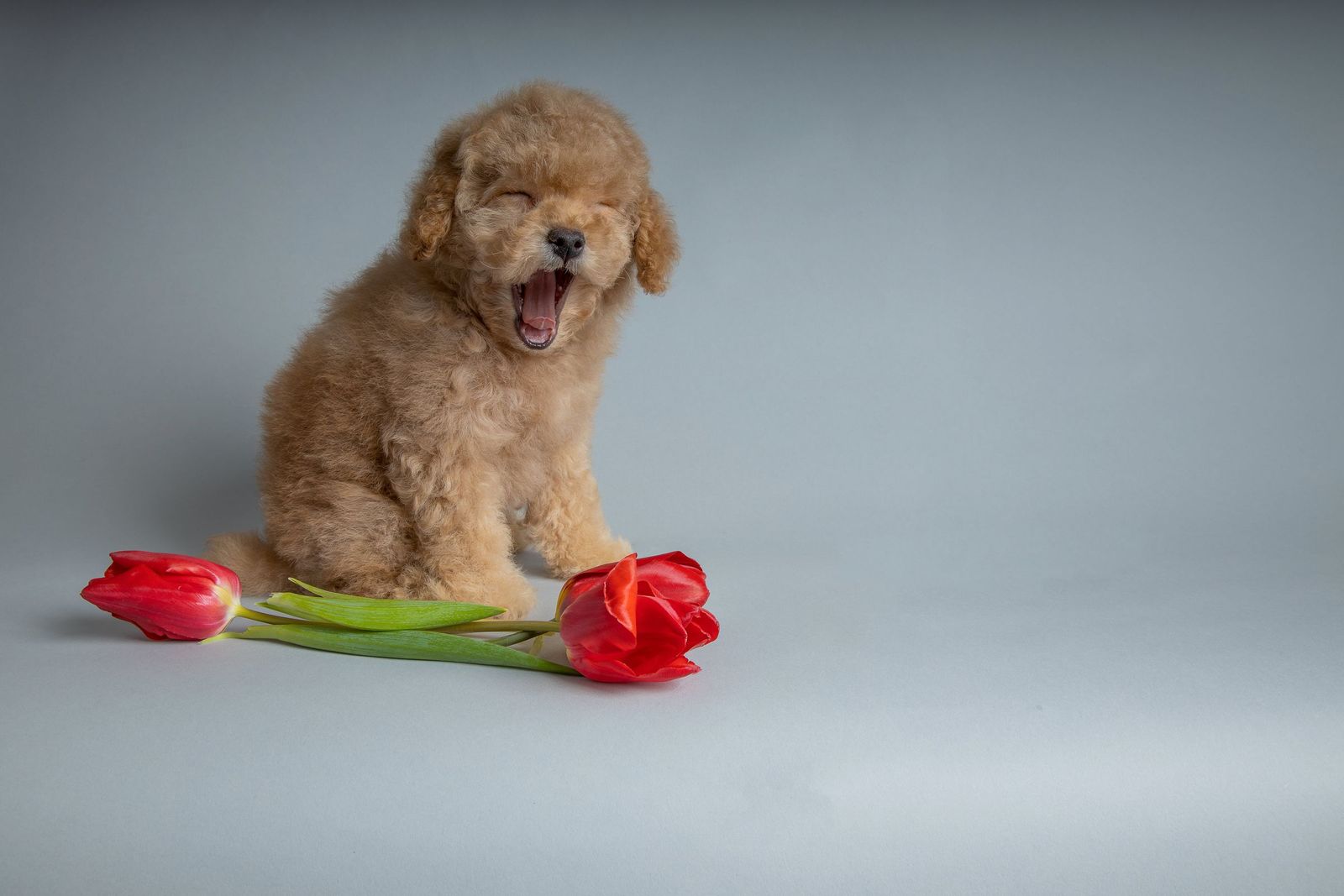
Somewhere between the third and seventh month, your Poodle swaps out its entire mouth: 28 puppy teeth out, 42 adult teeth in. Usually the rebuild passes with little more than extra chewing and the odd red smear on a toy. The schedule is the same in all four sizes; what differs is how often it goes wrong, and in the smallest varieties that is often enough to watch for.
The normal timeline: 28 puppy teeth, 42 adult teeth
Puppy teeth erupt while the litter is still with the breeder, from about three weeks of age, and the set is complete between six weeks and two months: 28 teeth. Since a puppy never leaves its mother before eight weeks, the dog that arrives on your first night at home already carries a full baby set.
Teething itself generally begins around three to four months, almost always with the incisors at the front, followed by the canines and premolars. By six to seven months the adult dentition is in place: 42 teeth. At the back of the jaw, molars erupt that had no milk predecessor, so they simply grow in new.
What you see is usually very little. Puppies tend to swallow their loose teeth while eating, so the collection jar on the windowsill stays empty. A trace of blood as a tooth comes free is normal, and shows up only as light staining on a toy.
Size shifts the timing
Small breeds change teeth later than large ones, so a Standard is often a few weeks ahead of a Toy from the same puppy class: a difference in pace, not in sequence.
Which size you have is worth pinning down, because registries divide the breed differently: the FCI recognises four varieties with the Toy at 24-28 cm, while the AKC (Toy capped at 10 inches) and the UK Kennel Club work with three. A Miniature registered in the United States or Britain may sit in the range the FCI calls Medium, and our guide to Poodle sizes compares the systems. For teething, what matters is how small the jaw is.
Retained puppy teeth: mostly a Toy and Miniature problem
Normally the root of a baby tooth dissolves as the adult tooth pushes up underneath, and it drops out by itself. When that fails, it stays put while the adult tooth erupts beside it: a retained or persistent deciduous tooth. It is emphatically a toy-breed issue, and in veterinary dentistry the Toy Poodle is named alongside the Yorkshire Terrier, the Maltese and the Chihuahua. Miniature Poodles are affected too; Standards far less often.
The canines are the usual culprits, upper canines most of all, then lower canines, then the incisors. The rule veterinary dentists apply is short: no two teeth belong in the same place at the same time. When one stays anyway, two things follow.
First, the adult tooth is pushed off course. If a lower canine is retained, the adult lower canine erupts on the inside instead, angled up with its tip pointing at the palate, where it can genuinely damage the roof of the mouth.
Second, you get crowding: two teeth in the space of one leave a gap that holds food and plaque, and in an already tight small-Poodle jaw that means tartar, gingivitis and eventually periodontitis. Why small Poodles are prone to dental disease at all is covered in Poodle dental care, high on the list of Toy Poodle health issues.
When to call the vet
The working standard: if the adult tooth is through and the baby tooth is still there a week later, it needs to come out, and soon. A retained tooth does not let go on its own.
One detail regularly goes wrong: do not save it for another anaesthetic appointment, such as neutering or spaying around six months. The sooner it is gone, the better the chance the adult tooth still drifts into place; wait too long and you are left with a misalignment only a specialist's orthodontic work can correct. Extraction is done under anaesthesia and demands careful technique, because a baby tooth root is thin and breaks easily, with the developing adult tooth right beside it.
So ask for the mouth to be checked at the appointments around four and six months, and look yourself in between: lift the lip, count the canines, watch for doubles. Whether extraction is covered varies by provider, worth checking in Poodle pet insurance. Call your vet too for persistent bleeding, clear pain, drooling, refusing food, a swelling in the mouth, or an adult tooth still missing after seven months.
Chewing while your Poodle is teething
Chewing relieves the pressure, and your puppy will want to test everything. Give it decent material, because here the classic mistake is made: too hard. Veterinary dentists use one rule of thumb, which is not to let your dog chew anything that will not bend. If you cannot dent it with a fingernail or flex it in your hands, it is too hard, so bones, antlers and rock-solid nylon are out, for adults as well as puppies.
What does work: flexible chew toys in a suitable size, and a fillable toy you freeze, since the cold soothes tender gums. Use the period to build a brushing habit too, starting with a finger brush and very short sessions, never with human toothpaste, for reasons set out in the brushing guide. The heavy chewing urge does not stop when teething ends: it usually settles around eighteen months.
In short
- 28 puppy teeth, complete between six weeks and two months.
- Teething runs from roughly three to seven months: incisors, then canines and premolars.
- End result: 42 adult teeth, including back molars with no milk predecessor.
- Swallowed teeth and a trace of blood are normal; small sizes finish later.
- A baby tooth beside an adult tooth is never normal: assess within a week, not at the neutering appointment.
- Chew material must bend, or teeth break; the chewing urge eases around eighteen months.