Poodle Harness or Collar: Which Should You Walk On?
By The Poodle Guide editorial team · Updated on August 11, 2026
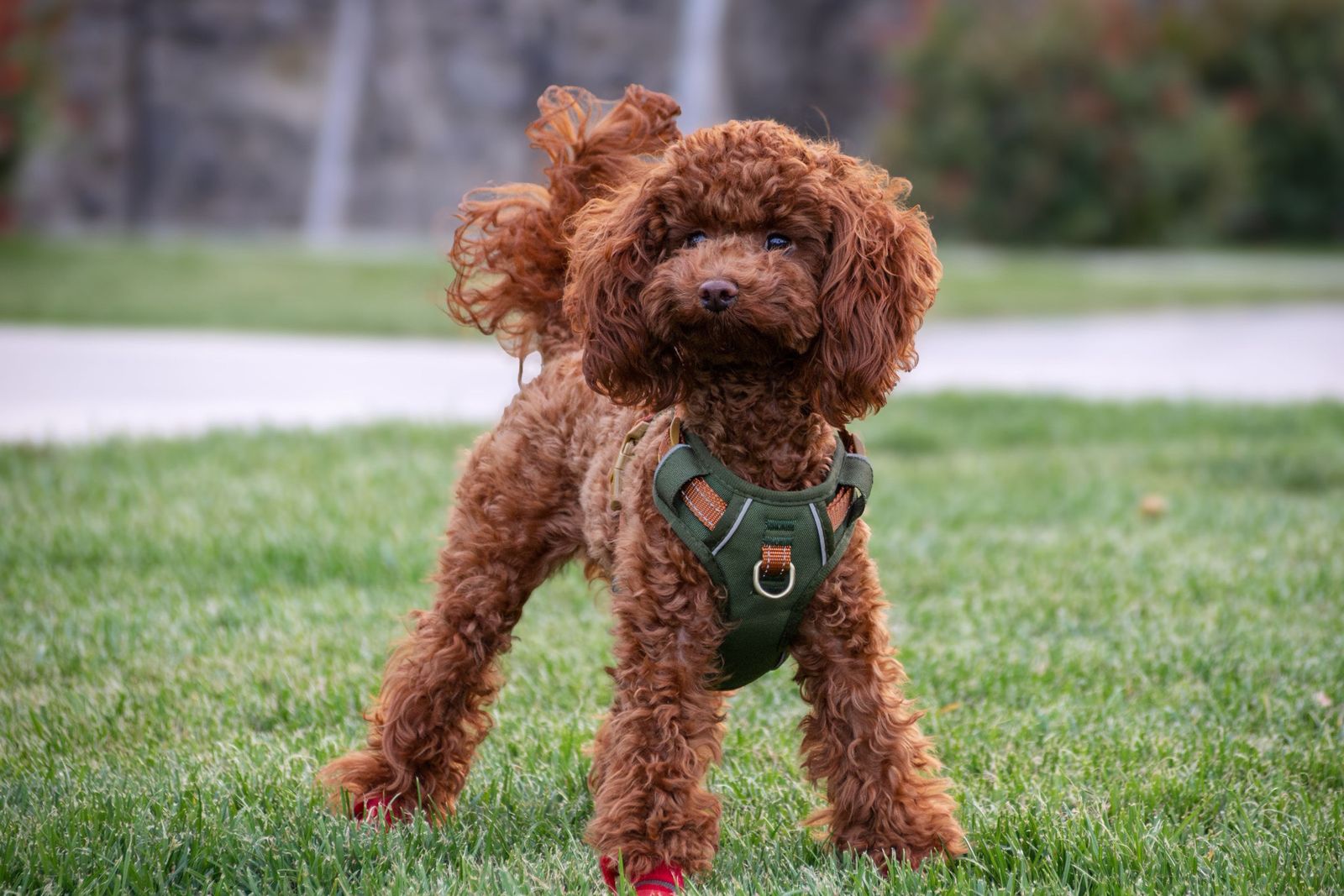
In the dog gear aisle the choice looks like a matter of taste: collars on the left, harnesses on the right. The reasoning changes with the dog, though. A 3 kg Toy and a 28 kg Standard both walk better on a harness, but for almost opposite reasons.
Same answer, different reasoning per size
The breed comes in four sizes under FCI rules, from the Toy at 24-28 cm to the Standard at 45-60 cm. American owners know three AKC varieties instead, with the Toy capped at 10 inches, and the UK Kennel Club recognizes three sizes of its own. Whichever registry you follow, the equipment question splits the same way.
At the small end the argument is anatomical. A Toy Poodle weighs 2-4.5 kg (4.5-10 lbs), so every bit of force traveling down the lead lands on a neck barely thicker than a child's wrist. At the large end it is mechanical. A Standard at 20-30 kg (44-66 lbs) is a powerful, athletic dog, and a lead on its collar gives you a narrow contact point on its most vulnerable part plus very little steering. A harness spreads that force across the chest and gives you a handle on the dog's center of mass instead of its throat.
The windpipe argument, and who it applies to
Inside that narrow neck runs the trachea, held open by C-shaped rings of cartilage. In some small dogs those rings soften and flatten with age, so the airway partly collapses. Cornell University's Riney Canine Health Center describes tracheal collapse as common in toy and small breed dogs such as Yorkshire Terriers, Pomeranians and Toy Poodles that are middle-aged or older. The signature sign is a dry, harsh cough often compared to a goose honk, worse with excitement, exercise, heat or pressure on the neck.
Among the management steps that center lists is switching from neck collars to harnesses. Note what that does and does not mean: the predisposition is largely structural, so no harness prevents the condition. It removes one daily source of pressure on an airway that may already be weakened. The other factor in your hands is weight, because obesity makes the symptoms worse, and on a three-kilo dog that line is crossed faster than owners expect. Our guide to a healthy weight per Poodle size covers the rib check, and Toy Poodle health sets out what the smallest size is prone to.
What the collar is still for
None of this retires the collar. A microchip is the identification that counts legally, but reading one takes a scanner and a registry lookup, while a tag on a flat collar lets the stranger who catches your dog phone you within a minute. In the UK it is also a legal requirement: under the Control of Dogs Order 1992, a dog in a public place must wear a collar bearing the owner's name and address. So: tag on the collar, lead on the harness.
Fit beats the label on the box
Y-shaped "non-restrictive" harnesses are widely marketed as proven better for shoulder movement, and the study most often invoked does not support that. Lafuente, Provis and Schmalz, writing in Veterinary Record in 2019, measured shoulder extension in nine dogs and found that all harnesses reduced it compared with wearing none. The non-restrictive designs came out 2.6 degrees lower at walk and 4.4 degrees lower at trot than the restrictive ones, the opposite of the marketing claim. Nine dogs is a small study and the differences are modest, so the fair reading is not that Y-harnesses are bad, but that the shoulder-freedom promise is unproven. Judge the harness in front of you instead:
- Low on the breastbone. The chest strap belongs on the sternum, not pressing across the underside of the throat.
- Shoulders free. The front leg should swing fully forward and back with nothing blocking it.
- Room behind the elbow. A belly strap sitting tight behind the elbow will chafe with every stride.
- Two fingers everywhere. You should be able to slide two fingers under every strap, at the narrowest point too.
- Re-check after grooming. A Poodle leaving a grooming appointment can lose enough coat to change the setting, and a growing puppy needs re-measuring.
What to leave on the shelf
Choke chains are not recommended for ordinary walking at any size. Neither is a retractable lead clipped to a collar: the dog builds up speed over several meters and is stopped by a jolt at exactly the point you were trying to protect. For more freedom, clip a long line to a well-fitted harness somewhere quiet. And a walking harness is not a car restraint; that needs a crate or a system built for the purpose, as covered in traveling with a Poodle.
Equipment does not fix pulling
A harness takes pressure off the neck. It teaches your dog nothing. If your Poodle leans into the lead like a sled dog, that is a training question: reward the position beside you, change direction the moment the lead goes tight, and keep sessions short. This is the second most trainable breed in the world by Coren's ranking, and most Poodles pick up a new cue in under five repetitions. On a strong Standard Poodle in particular, loose-lead training matters more than any hardware you can buy. And a dry, harsh cough, especially when excited or on the lead, calls for a vet appointment rather than a shopping trip.
In short
- Lead on the harness, ID tag on the collar: the safe default at every Poodle size.
- For Toys and Miniatures the reason is the trachea; for Mediums and Standards it is force and control.
- Cornell names Toy Poodles among breeds prone to tracheal collapse and lists harnesses as part of management; obesity makes it worse.
- Y-harnesses are not proven better for shoulder movement. Buy on fit, not on the packaging.
- No choke chains, and no retractable lead on a collar.
- Pulling is solved with training, not with different hardware.